What is the effect of immigration to the United States on Mexico?

Most only think of the effects illegal immigration has on the United States but it also affects the countries they are immigrating from. The undocumented Mexicans who come into this country sent approximately 9 billion dollars home in remittances. This is money directly funneled into the pockets of Mexican citizens. Instead of funneling that money back into the US economy they send it back to improve the Mexican economy.

The 10 million Mexicans immigrating into the US are also bodies Mexico doesn’t have to take care of anymore. The Mexican government doesn’t have to educate their children, incarcerate if they have committed a crime, build roads for or take care of when injured or sick.

It isn’t all good for Mexico though. The people deported from the United States are often just dropped at the border with nothing but the clothes on their back. Often they have no place to go as their lives have been mostly lived out in the United States. These people create a burden for the Mexican economy. They are able bodied men, but there is not enough work for all of these people in the small space where they are dropped off. Many deportees often lie and say they are from Mexico just to be dropped off close to the United States, in hope of returning. This means that Mexico isn’t just supporting those people who emigrated from Mexico, but those who went from other countries as well.

What is the net cost/gain of immigration on Mexico?

http://www.latimes.com/news/opinion/letters/la-le-0601-friday-deportees-20120601,0,816328.story

http://www.fairus.org/home

Posted in Uncategorized | Leave a comment

Childhood in the U.S. During the 1850-1900′s

During 1850-1900, America grew significantly, in terms of geographical size; it was an era of growth for America. Along with the Louisiana Purchase that doubled the nation’s size and expanding to North America, America had the newly constructed transcontinental railroad that brought more people and business to west – this opened out more job opportunities and living space for people. The civil war that freed African Americans from slavery also contributed to the bright sides of the time period.

            Nonetheless, various political corruptions and difficulties still existed. Even with America as a country growing big and strong every second, people, regardless of age, race and sex, experienced hardships in their lives. Poverty was still a big part for the majority; all parents went out to work all day and many even died due to starvation and diseases from bad hygiene. Children were getting directly affected by this problem. They lost adults to take care of them and teach them. Not knowing the importance of education, a lot dropped out of school to become part of a street gang or to work in factories.
 (Homeless children keeping warm on a steam vent in NYC)

            Some were even abandoned by their parents, who couldn’t afford to raise them. Groups of homeless children lived in streets together. They didn’t know what to do or expect in their lives, like lost sheep without a shepherd to guide. Fortunately, there were some that noticed this crisis and wanted to give these children new lives. In eighteenth-century Virginia, courts separated children not only from poor parents but also from those who were not providing good education. They started to protect the young from danger and hoped to bring better future for them; they began to focus on the best interest of children.

            In 1875, the first Society for the Preservation of Cruelty to Children was founded to enforce child protection laws. With help from other similar organizations, they sent thousands of children out of streets to live with other families. Gradually, people started to realize the significance of family preservation and provide more care for children. There, however, were still a lot of children in need of help out there.

*Textbook
*http://www.u-s-history.com/pages/h1061.html
*http://education.stateuniversity.com/pages/1828/Child-Protective-Services.html
*http://www.historyplace.com/unitedstates/childlabor/about.htm

Posted in Uncategorized | 1 Comment

1900-1914

1900-1914 was a happy quiet time for America. There hadn’t been a world war yet, the Panama Canal had just been completed, bringing prosperity and strength to America. America still though it was the best of the best as it’s illusions hadn’t yet been crushed by the upcoming war. Taft was overseeing his Dollar Diplomacy, putting American businesses in South America and showing everyone that we were the best. Children in this age were going through a middle period. There still weren’t any rules about compulsory education although regulations were put in place for how much they could work. Their families, while not completely poor at the time were still majorly lower middle class. While not glamorous, this time period was better than anything the next 20-30 years would bring for children.

While there were private academies for the wealthier, the majority of children that went to school went to public schools. On average there were twenty to thirty children to a classroom in a public school versus 4-6 in a private school. Corporal punishment was highly used and encouraged at this point in time, a rap on the hands with a ruler or a paddle or get a box on the ears. School, while still mostly reading, memorizing and reciting had become more than just books in this period. Sports such as tennis and swimming were being taught at some places. Some teachers even did experiments. School was recommended until age 16 but most only stayed until eighth grade. Not everyone got to go to school at all though. There were still many children of the lower class who still had to go work in the factories, farms or coalmines to help support their families.

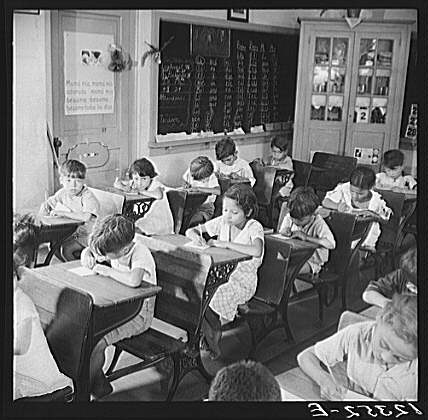
Most city schools looked something like this at this time: various grades taught in the same room by the same teacher.

The children in this period were the last ones to truly have a chance a happiness. After this time period their fathers were either being taken to war, often never coming back, or their families were being forced in to the enormous poverty that overtook the country during the Great Depression. Not to mention that after the Great Depression ended more fathers were being taken away from their families by World War II. Whether it was a blessing or a curse to have been born during this time is unclear. On on hand, you had a nice safe warm childhood but on the other instead of it being your father who is drafted, if you were a boy you yourself could have been drafted.


Textbook

http://library.thinkquest.org/J002606/early1900s.html

http://www.macgregoss.eq.edu.au/federation/histschool/1901.html

Posted in Uncategorized | 1 Comment

1900-1914

In the 1900’s, the birthrate in the United States was 32.2 births per thousand people, the average number of children in a family being 3.56. As more people immigrated into the city, and with the lack of any birth control, the population grew. However, there was not enough housing, most people had to work at demeaning jobs to survive, and not many people were around to take care of the children. Most poverty working class children had to fend for themselves. Jobs in the mills were common, as well as jobs in mines and being newsboys.

Boys enjoy lighting up a cigarette as much as a grown man would. They look kind of smug.

As usual, working class children did not have a normal childhood. The boys worked alongside men in mines and lumber plants, playing pool during break time and smoking. Newboys could be found shooting craps in alleyways as a past time. They also fought for fun.

Boys fight for fun

A group of newsboys playing craps in the jail alley at 10 p.m. Albany, New York.

Children, both boys and girls began working as young as five years old to help support their families. This meant that most spent their childhoods working and risking their lives working at dangerous jobs. Newsboys jumped out of moving trolleys and often caught pneumonia and other illnesses because of standing out late at night in the cold weather. Boys in the mines aged quickly and their health diminished rapidly. The fact that some boys enjoyed visiting whore houses adds to the fact that childhood just didn’t exist or ended around age five before they started working.

Richard Pierce, age 14, a Western Union Telegraph Co. messenger, works from 7 a.m. to 6 p.m. Smokes and visits whore houses.

Dirty miner boys

Their faces still have baby fat but they already have lines and wrinkles.

City girls worked in mills spinning cotton. Most earned around 40¢ a day. Farms girls both African American and white picked pails of berries from 4AM till sunset. Some boys as young as six picked cotton and tobacco, carrying bags as heavy as 40 pounds.

Girl in the mill who didn't remember her age when asked. She worked nights sometimes.

There isn’t much information provided on what girls did for fun, but maybe they went to the library and checked out books like Francie (From the novel A Tree Grows in Brooklyn which depicted this time period from a young girl’s point of view).

As always, the fortunate middle class or high class children went to school or got private education. For fun girls played with dolls and had tea-time. The boys went horseback riding or played sports. Higher class children were usually healthy (with the exception of natural illnesses such as colds). For the working class children who eventually attended school: the dropout rate for children over the age of 12 was 96%.

During this time period, many children had to work long hours to survive. Their families depended on them, and most families had around three children. They were usually all sent to work. Some children stayed at home and helped their parents at their at-home sweat shop businesses. Even at home they worked in unsanitary conditions. It’s disconcerting to realize children from age 5 were working from sunrise to sundown. Children nowadays go to school for less than those hours, even high schoolers and some college students. It’s even more disturbing to know that they started smoking at an early age and went to whore houses, with some young girls as prostitutes. As much as I wish these kids didn’t have to go through this, this was reality, and the Gilded Age. Beneath all the productivity and the prosperity were the dirty children who were exploited for their labor. How disillusioning.

Citations:

Posted in Uncategorized | 2 Comments

Childhood in the U.S. During the 1900-1914′s

 In the early 1900s, the United States was in the Progressive era, period of various reforms. The government at that time was polluted with social injustice; it was in need of purification. People who noticed these problems fought together to bring fair rights and liberty back in to the society. As new reforms were made, lives of many were improved. But there was one major problem that was left unnoticed until the very end: child labor.

            No matter how morally wrong child labor was, it was inevitable. Poverty wasn’t foreign to most of the people. Even with both of the parents working day and night, a lot of families barely had any food to keep them alive. Students of certain age quit their school to go work instead. It became a problem when the children under a minimum legal age started to work for full-time in factories, mines and sweatshops. They worked all day under an extremely dangerous working condition for a low income. It was common to see children getting injured while working with unsafe tools and sick due to the health issue.

(http://twentytwowords.com/2010/11/24/15-photographs-of-child-labor-in-america-from-the-early-1900s/)

            People, however, supported child labor greatly. They liked that the children could help increase the income. Some even believed that working experiences is better than education from school. Fortunately, there were also groups of people upset with child labor; they knew it was wrong and needed to be stopped. In 1904, National Child Labor Committee was formed to protect the children’s rights. They started campaigning for federal child labor law reforms and raised awareness. The public realized shortly the urgency and severity of the problem. National Child Labor Committee’s effort eventually resulted in fair labor standards act in 1938, which set standards for child labor.

            True, child labor could be highly beneficial. But children also have rights to have their childhood that will never come back once it’s gone. People need to give children opportunities to spend their childhood with friends at school and respect their choice.

* Textbook
* http://www.continuetolearn.uiowa.edu/laborctr/child_labor/about/us_history.html

Posted in Uncategorized | 1 Comment

1900-1914

In the 1900s, children, both boys and girls were put to work to help support their families. Most of these children were as young as five years old when they began to work. The boys were commonly put to work by selling newspapers and such. A lot of times, the boys would still be out doing their job in the rain, resulting in them having pneumonia. This was something that was very common during this period in time. As for the girls, they weren’t put to much work but when they did have to, most of the girls would be out picking pails of berries to bring back home. They were taught by their mother, how to do things around the house.

As far as means of transportation were concerned, motor cars were the new way to get around places. In 1903,  Henry Ford established what was called Model A Car. As soon as this was brought out for people to see and buy, Ford’s company was a huge success. Auto mobles became very popular. Just as he thought things couldn’t get any better, he produced the new Model T Car. The new and improved manufacturing made the cars quicker and cheaper. This made it easier for people around town to purchase a car. The picture below shows an actual Model T Car.

Another important subject of the 1900s was the education of children. Many familes weren’t able to put their children into a school because of financial problems. Immigrant families especially could put their children in school because the children had to stay home and help work to support the family. On the other hand, middle and upper class families were able to put their children to school. Many of the children were able to go on to high school. Later on in the 1900s, the economy began to improve which made it possible for more families to put the children into high school. Unfortunately African American children were deprived of having the chance to go to school to get an education. They were put into segregated schools and in a way, got the shorter end of the stick with the lower level resources.

-Lauren Lake Claro

Posted in Uncategorized | 1 Comment

Children: 1850-1900

1850-1900 was a very tumultuous period for America. While had grown in size a tremendous amount in the past years, by 1950 it stretched across North America, it had yet a different kind of growth up ahead. The Civil War took place in this time, freeing African Americans from the bonds of slavery bringing with it a huge loss of life. This was also a time of great political corruption such as gerrymandering. The transcontinental railroad was also finished during this time bringing lots more travel out west. All these changes also meant changes for the children too.

While this may have been an increasingly difficult time for African American children, most children had it pretty bad during this era. With rising industrialism children were often required to work to increase the household income. Since about 1830 children had been working increasingly long hours in increasingly dangerous spaces. Working at such a young age often caused deformities; in some cases if a child was required to hunch over, as was the usual case, they would develop scoliosis and have to suffer from that for life. Scavengers and Piercers, jobs that children often had in textile factories were only some that would often cause these conditions. But this was also a time when reforms were starting to take place. People like Mother Jones, for example, were speaking out for the rights of children and speaking out for compulsory education.

Here is an illustration of several children working in a textile loom factory. They are doing the work of Scavengers and Piercers. The Scavengers are the younger ones while those at about 12 or 13 did the job of Piercers.

This work, while not only dangerous and utterly awful, also contributed to low literacy rates, among all races. They were working in the factories all day so they could never go to school. This made the already huge divide between the rich and the poor that much deeper. Not only were the poor looked down upon because of their work, they also could never hold an educated conversation because they had never been educated. Only reformers like Mother Jones did something to improve the conditions that would lead to the life we live today, where regardless of your economic class you are entitled to an education.

Textbook

http://www.spartacus.schoolnet.co.uk/IRscavengers.htm

http://www.questia.com/library/book/immigrants-and-their-children-1850-1950-by-e-p-hutchinson.jsp

http://gfxtra.com/dl/Americas+Children+1850-1930+Years+2

http://www.spartacus.schoolnet.co.uk/IRchild.htm

Posted in Uncategorized | 1 Comment

1850-1900

In the 1850’s through 1900’s, children were involved in many situations that were too gruesome for their young age. Booming urbanization forced kids to work in factories or to live in the streets. With the outbreak of the Civil War, many children either joined the war effort by enlisting in the army in the south or working in factories in the north.

Powder Monkey boy from the Civil war

Civil War: Drummer Boys, 1863

At the height of urbanization, with massive population growth from immigrants from Europe and deepening poverty, many children were forced out into the streets. Their parents couldn’t take care of them while working meaningless, low paying, full time jobs or they were simply orphans with nowhere to go. Children formed streets gangs, pick pocketing, or labored in street jobs such as shoe shining,  sweeping side walks or selling newspapers. They slept in gutters and alleyways. One report in 1886 claimed that 12,000 homeless youths were wandering around the streets nightly.

When the Civil War broke out, children in the south enlisted to be a part of the army. In 1861, President Lincoln announced that children under 18 had to have parental consent to enlist and then prohibited enlistment of any children under 18 the next year. However, heavy casualties forced recruiters to look the other way when young children tried to enlist. Many boys went to war as drummers, messengers, hospital orderlies or full fledged soldiers. Boys as young as nine were enlisted as drummer boys. Everyone knows that they were the first ones shot because without them, the army would march to no beat and therefore be susceptible to get out of line. In the Navy, boys signed up to be Powder Monkeys. They kept cannon crews supplied with gunpowder and cannon balls.

Again, childhood didn’t exactly exist for these children. Taking part in war, for patriotism, pride, or reasons of their own, children had to grow up fast and were disillusioned by the death and horrors of war. Children in the north who slept in gutters made no time to go to school and resorted to a life of thievery. While most were eventually returned to their parents by the police, most died on the streets. In many ways, children from the 1850-1900’s experienced so much more in life than teenagers in modern times. None of us had to endure war at such an early age, or had to live in squalor or grow up in the streets (beside the teens who run away from home).

Citations:

Posted in Uncategorized | 1 Comment

Childhood in the U.S. During the 1750-1850′s

As the time period came closer to 1800’s, America went through memorable events, which includes declaration of independence from Britain. The Americans enjoyed the long-awaited independence, but it only lasted briefly. America was a new-born that needed to grow as a strong country and the children during 1750s-1850s contributed by helping the adults.

Although the quality of life had improved than before, most children didn’t have easy lives. Because the adults were busy creating the new nation, the children didn’t have people to take care of them and as a consequence, they became responsible for their work. Even at young age, they were expected to help the adults with the work and keep up with their study at the same time. But not every child shared same amount of difficulties; it varied according to the wealth she or he had.

  (The first photo: The clothing of poor children were not as fancy as the rich’s. They were plain and loose. The second photo: The girls from a well-off family often wore dresses with puffy sleeves and a lot of lace and ribbons.)

It was rather easy for the rich, who were provided with everything needed. The rich were taught manners to become gentlemen and had essential education. The poor, however, weren’t fortunate as the rich did. A lot of them spent time more in their family farm school. They learned skills they can use at work, but not in the bigger world which the rich children will be part of later. The life style of rich and poor children differentiated not only in education but also in clothing. The rich wore neat clothing that was made of good quality, while the poor wore big and loose clothing, so that siblings can wear them again.

The gap between rich and poor started to widen and the children were the biggest victims. From the early stages of their life, they were treated very differently than another. This difference became the root of rich holding the central power and poor being disadvantaged from it in future.

*Textbook
*http://www.faqs.org/childhood/Bo-Ch/Child-Care.html
*http://www.historycentral.com/nn/America/Children.html

Posted in Uncategorized | 1 Comment

Childhood in the U.S. During 1850-1900’s

During this time period, the American Revolution was taking place. There were many events that occurred in this era as well. In Britain, the population during this time grew rapidly. Not only did this happen in Britain but in other places too.

As far as childhood was at this time, children were expected to act their best around other children and especially towards the adults. Discipline was something that was very important for the adults to see in children. The education for the children were mostly provided for the ones that had the money. They were taught many things. Most classrooms looked similar to this one shown below.

In the classrooms they were taught common things such as learning how to write and read. It was important for children to get an education so they wouldn’t have to live the hard life during that time. If they succeeded in school then they were set off to have a brighter future.

-Lauren Lake Claro

Posted in Uncategorized | 1 Comment